RUGSURE Washable Area Rugs: What This Rectangular Rug Brings to a Living Space
RUGSURE Washable Area Rugs merge a machine-washable microfiber face with a built-in non-slip rubber backing, combining two functions that are typically handled by separate products. This RUGSURE washable area rugs review looks at how the 3′ x 5′ rectangular rug, finished in a rust-toned vintage tribal pattern, performs across the factors that matter most to shoppers furnishing a living room, bedroom, kids’ room, or nursery. A rug in this category is expected to do more than fill visual space between furniture pieces; it needs to withstand foot traffic, resist slipping on hard flooring, and tolerate the spills and messes common in households with pets or young children. The 3′ x 5′ size places this rug in the accent-rug category rather than a full room-anchoring piece, making it best suited for smaller zones such as a reading nook, an entryway transition, a spot beside a bed, or a layered accent under a coffee table in an otherwise larger room. Material composition, backing type, and printing method all influence how the rug looks, feels, and holds up over repeated use and washing cycles, and each of these characteristics is addressed in the sections that follow.
Quick Overview
| Feature | Details |
|---|---|
| Product Type | Washable area rug, rectangular |
| Brand | RUGSURE |
| Size | 3′ x 5′ (60″L x 36″W) |
| Material | Microfiber face, rubber backing |
| Construction | Machine woven, digitally printed pattern |
| Pile Height | Low pile |
| Weight | 1.87 kilograms |
| Thickness | 0.25 inches |
| Special Features | Non-slip, water resistant, stain resistant |
| Color / Pattern | Rust, floral tribal medallion design |
| Recommended Rooms | Living room, bedroom, kids’ room, nursery, dining room, study |
| Care Instructions | Machine washable, air dry or tumble dry no heat |
These specifications translate into a lightweight, low-profile rug that can be moved, rotated, or laundered without special equipment. The low pile and thin 0.25-inch profile allow doors to swing freely over it and reduce tripping risk compared to plush, high-pile rugs. The rubber backing is designed to grip hard flooring, while the microfiber face is engineered to tolerate regular washing, a combination aimed at rooms where spills, pet traffic, or child activity are routine concerns.

RUGSURE Washable Area Rugs Review: Sizing and Room Layout Considerations
A 3′ x 5′ rectangular footprint is classified as an accent or scatter rug rather than a room-defining centerpiece, which shapes where it performs best. In a living room, this size typically works in front of a single chair, beside a sofa, in a reading corner, or layered atop a larger neutral rug for visual contrast rather than placed beneath a full seating group. In bedrooms, kids’ rooms, or nurseries, the same footprint comfortably sits beside a bed or crib, or centers a small play area, without overwhelming the room. Buyers furnishing a larger open-concept living room should treat this size as a supplementary piece rather than the primary flooring solution, since it will not reach under furniture legs the way a 5′ x 8′ or 8′ x 10′ rug would in a spacious layout.

Best-Suited Room Types and Zones
The dimensions make this rug most practical for entryways, reading nooks, bedside placement, or accent layering in front of a media console. Its low profile means it will not create a noticeable step-up transition between rooms, which matters in open floor plans where multiple flooring types meet. For a nursery or kids’ room, the compact size fits neatly beneath a rocking chair or within a play corner without requiring the furniture to be rearranged around it.
Furniture Arrangement Compatibility
Because the rug measures only 36 inches wide, it will not extend under the front legs of a standard sofa or sectional, which is the placement convention interior designers generally recommend for anchoring a seating area. It is better suited to sitting fully beneath a single accent chair, a small side table, or positioned as a runway piece in a hallway-adjacent living space rather than as the sole rug in a large-format room. Buyers can also consider it as a layering piece over a larger neutral rug, a styling approach that adds pattern and warmth without committing an entire room to the tribal motif.
Material Composition and Underfoot Comfort
The rug’s face is constructed from microfiber, a synthetic fiber known for a soft, velvety hand-feel and consistent texture across the surface. Combined with a low pile height, the material sits close to the floor rather than standing up in long strands, which affects both comfort and function. Low-pile microfiber rugs tend to feel smooth and dense underfoot rather than plush and sinking, a texture that many households prefer for high-traffic zones because it resists matting and crushing over time. The 0.25-inch thickness keeps the rug thin enough to work under doors and furniture while still providing a soft buffer between bare feet and hard flooring such as tile, laminate, or hardwood.

Microfiber Face Fiber Characteristics
Microfiber is prized in washable rug construction because the fine synthetic strands resist absorbing moisture and odor as readily as natural fibers like wool or cotton can. This makes the surface feel smooth rather than nubby, and it contributes to the rug’s ability to roll out flat without creasing, a detail specifically noted in the manufacturer’s product description as a feature of the construction.
Low Pile Height in Practical Terms
A low pile height reduces the amount of debris, pet hair, and dust that can become trapped deep within the fibers, which simplifies vacuuming and everyday upkeep. This pile height also lowers the rug’s overall profile, an advantage in rooms with swinging doors, rolling furniture, or where a flush transition between the rug edge and surrounding floor is preferred for safety.
Durability and Non-Slip Performance in High-Traffic Areas
Machine-woven construction generally produces a more uniform, tightly bound surface than hand-tufted or hand-knotted alternatives, and it pairs here with a rubber backing intended to keep the rug anchored on hard flooring. This combination targets two separate durability concerns at once: fiber-level wear from foot traffic and positional slippage that causes rugs to bunch, curl, or migrate over time. In households with children or pets, both of these failure points are common complaints with lower-quality rugs, so a bonded non-slip backing is a meaningful structural feature rather than a cosmetic add-on. The trade-off with an integrated rubber backing is that it is less flexible for spot-treating the underside separately from the face and may require monitoring for wear at the backing’s edges after repeated wash cycles.

Machine-Woven Construction and Wear Resistance
Machine weaving allows for tighter, more consistent fiber density than many handmade techniques, which generally correlates with better resistance to flattening and shedding in areas that see daily use. The digitally printed pattern is applied with the level of detail the manufacturer states cannot be replicated by hand, meaning the design is embedded into the surface rather than woven fiber-by-fiber in multiple yarn colors.
Non-Slip Backing Function on Hard Floors
The rubber backing functions as a built-in anti-slip layer, reducing the need for a separate rug pad or double-sided tape, which is a common workaround for lightweight rugs on tile, laminate, or hardwood. This is particularly relevant in high-traffic pathways, where an unanchored rug edge can become a tripping hazard.
Suitability for Pet and Child Activity
Low pile height combined with a securely gripping backing supports more stable footing during active movement, an important characteristic for households where children play on the floor or pets move quickly across rugs. The tight weave also limits the depth to which claws or crumbs can penetrate compared to a shag or high-pile alternative, which can help reduce the frequency of deep cleaning required in rooms with heavy daily use.
Washability and Long-Term Maintenance
Machine washability is the defining functional claim behind this rug, positioning it as a lower-maintenance alternative to rugs that require professional cleaning or spot treatment only. The manufacturer specifies washing with mild detergent, avoiding bleach or fabric softener, and either machine or air drying without heat, guidance that mirrors standard care instructions for synthetic microfiber textiles. Stain and water resistance further reduce the urgency of immediate deep cleaning after minor spills, since liquids are less likely to soak into the fiber before they can be blotted or wiped. For households managing frequent messes from young children, pets, or high foot traffic, the ability to launder the entire rug rather than relying solely on spot cleaning represents a meaningful shift in how maintenance time is spent over the life of the product.

Machine-Wash Process and Practical Limits
At 1.87 kilograms and a compact 3′ x 5′ footprint, the rug is light enough to fit into a standard home washing machine, unlike larger area rugs that typically require professional or industrial cleaning equipment. This weight and size advantage is specific to smaller accent rugs and would not extend to larger room-sized rugs even if constructed from the same materials.
Stain and Water Resistance in Daily Use
Stain and water resistance function as a first line of defense rather than a permanent barrier, meaning spills should still be addressed promptly even though the fiber is designed to resist immediate absorption. This characteristic is most valuable in dining-adjacent living spaces, kids’ rooms, and entryways where liquid and food contact is more frequent than in formal, low-traffic rooms.
Drying Recommendations and Fiber Care
The manufacturer’s no-heat drying guidance is consistent with general best practices for synthetic rug fibers, since high heat can affect the rubber backing’s flexibility and adhesion over repeated cycles. Air drying or low-heat tumble drying helps preserve both the printed pattern’s vibrancy and the structural integrity of the backing layer across repeated wash-and-dry cycles.
Style, Pattern, and Color Compatibility
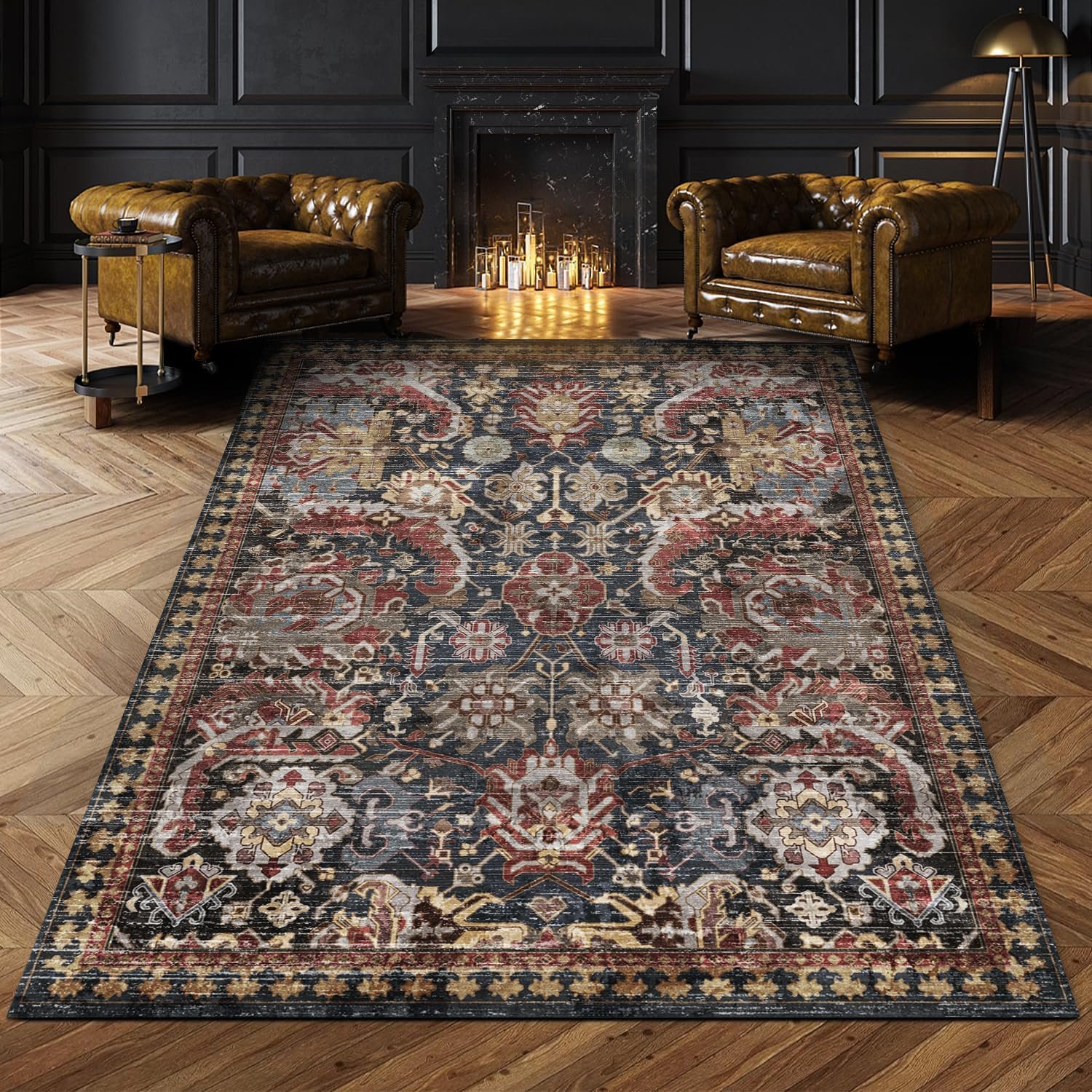
The rug’s design pairs a vintage-inspired ornate medallion with a distinct border, rendered in rust, honey beige, and cream tones with intentional distressing built into the print. This places the rug within the broader vintage tribal and Persian-inspired category that has remained a consistent presence in living room, bedroom, and transitional interior styling. The rust-forward palette functions as a warm accent color capable of pairing with neutral flooring, natural wood tones, and earth-toned furniture, though it will contrast more strongly against cool-toned or heavily patterned existing decor. Because the pattern is digitally printed rather than woven in multiple yarn colors, the visual detail achievable in the medallion and border work is generally finer than what comparable hand-loomed construction could produce, though the tactile texture reads as flatter than a hand-knotted equivalent.
Vintage Tribal Medallion and Border Design
The central medallion and framing border follow a traditional area-rug layout commonly associated with Persian and tribal design lineages, a style that tends to read as more traditional or eclectic than minimalist or contemporary decor schemes. Buyers furnishing a strictly modern or Scandinavian-style room may find the ornate detailing a stronger visual statement than a solid or geometric alternative would provide.
Rust Colorway and Room Palette Pairing
Rust functions as a warm, mid-saturation accent that complements cream, tan, olive, and walnut-toned furnishings commonly found in living rooms and bedrooms. It is a less flexible choice in rooms built around cool grays, blacks, or jewel tones, where the warmth of the rust may compete with rather than complement the existing palette.
Digitally Printed Detail vs Traditional Weaving
Digital printing allows for gradient shading and fine linework within the distressed medallion pattern that would be difficult to replicate through traditional multi-yarn weaving at this size and category. The visual payoff is a more intricate design, though the surface pattern sits on top of the fiber rather than being woven through it, a distinction some buyers accustomed to hand-knotted rugs may notice on close inspection.
Pros & Cons
Pros
- The combined non-slip backing and washable face eliminate the need to purchase a separate rug pad, simplifying setup on hard flooring surfaces.
- Machine-wash compatibility allows the entire rug to be laundered at home rather than requiring professional cleaning, which is unusual for area rugs of any size.
- Low pile height and 0.25-inch thickness make the rug easy to vacuum, roll, transport, and fit beneath doors without catching on the threshold.
- Stain and water resistance provide a buffer against everyday spills common in kid- and pet-friendly households, reducing the urgency of immediate cleanup.
- The digitally printed vintage tribal design achieves a level of pattern detail that is difficult to match through traditional multi-color weaving methods.
- Machine-woven construction generally offers more consistent density and wear resistance than lower-cost hand-tufted alternatives.
- At 1.87 kilograms, the rug is light enough for one person to reposition, rotate, or remove for cleaning without assistance.
- A 4.4 average rating across a large volume of customer reviews suggests broad consistency in how the product performs once in households.
Cons
- The 3′ x 5′ size limits the rug to accent placement and will not anchor furniture groupings the way a larger area rug would in a spacious living room.
- The rubber backing, while functional for grip and washability, is bonded to the fiber and cannot be replaced or serviced separately if it degrades faster than the face material.
- The vintage tribal pattern and rust colorway suit traditional and eclectic interiors more naturally than strictly modern or monochrome color schemes.
- Digitally printed designs sit on the fiber surface rather than being woven through multiple yarn colors, which may read as less tactile than hand-knotted alternatives to close inspection.
- Low pile height, while easy to maintain, will not provide the plush cushioning of a high-pile shag rug for buyers prioritizing a deep, soft underfoot feel.
Final Verdict: Who This Living Room Product Is Best For (and Who Should Skip It)
RUGSURE Washable Area Rugs are best suited to households that prioritize practical maintenance over room-anchoring scale, particularly homes with children, pets, or high-traffic zones near entryways, play areas, or bedside spots. The combination of a non-slip rubber backing and full machine washability addresses two recurring frustrations with small accent rugs: slipping on hard flooring and the inconvenience of professional or spot-only cleaning. The rust-toned vintage tribal design further suits traditional, eclectic, or warm-toned interiors where an ornate medallion pattern complements existing wood and earth-tone furnishings.
Buyers furnishing a large, open-concept living room around a full seating group should look elsewhere, since the 3′ x 5′ footprint functions as an accent piece rather than a foundational rug. Those decorating in a strictly modern, minimalist, or cool-toned palette may also find the pattern and rust coloring a visual mismatch. For smaller zones, kids’ rooms, nurseries, or households managing frequent spills and pet traffic, this rug represents a practical, low-maintenance option among washable area rugs available in 2026, particularly for buyers who value at-home laundering over the plush thickness of a traditional high-pile rug.
Frequently Asked Questions (FAQs)
Can RUGSURE washable area rugs be cleaned in a standard home washing machine?
The rug is designed to be machine washable using mild detergent, without bleach or fabric softener. At approximately 1.87 kilograms and a compact 3′ x 5′ footprint, it fits within the drum capacity of most standard home washing machines, unlike larger area rugs that typically require professional or industrial cleaning equipment due to their size and weight. This makes routine deep cleaning more accessible for everyday households without added expense or scheduling effort.
Does this rug stay in place on hardwood or tile flooring?
The rug includes a built-in rubber backing designed to grip hard flooring surfaces such as hardwood, tile, and laminate, reducing the likelihood of slipping without requiring a separate rug pad. This backing is intended to keep the rug anchored during regular foot traffic and furniture movement nearby, though grip performance can vary somewhat depending on floor texture, surface cleanliness, and how frequently the rug is moved or rolled up.
Is the RUGSURE area rug suitable for households with pets or young children?
The low pile height, stain and water resistance, and non-slip backing are characteristics generally associated with pet- and child-friendly rugs, since they resist tracked-in debris and support steadier footing during active movement across the surface. The machine-washable design also allows the entire rug to be laundered after messes rather than relying solely on spot cleaning, which is a practical advantage in households managing frequent spills or shedding.
What size room is a 3′ x 5′ area rug best suited for?
A 3′ x 5′ rug is classified as an accent or scatter rug rather than a room-anchoring piece, making it best suited for smaller zones such as entryways, reading nooks, bedside placement in a bedroom or nursery, or layering under a coffee table. It is generally too small to extend beneath a full sofa or sectional seating group in a larger living room, where a bigger rug size would be more appropriate.
How should the rug be dried after washing?
The manufacturer recommends either machine drying on a no-heat or low-heat setting, or air drying the rug flat once washing is complete. Avoiding high heat helps preserve the flexibility of the rubber backing and the vibrancy of the digitally printed pattern over repeated wash cycles, which is consistent with general care guidance for synthetic microfiber textiles used in washable home rugs and similar soft furnishings.
What is the rug’s face material made from?
The rug’s face is constructed from microfiber, a synthetic fiber known for a soft, velvety texture and greater resistance to moisture absorption compared with natural fibers like wool or cotton. This material choice supports both the washable design and the smooth, low-pile feel underfoot described in the product specifications, while also contributing to the rug’s ability to roll out flat without creasing or retaining odor over time.
Does the vintage tribal pattern suit modern interior styles?
The ornate central medallion, distinct border, and rust, honey beige, and cream color palette are more closely aligned with traditional, eclectic, or transitional interior styles than with strictly modern or minimalist decor. Buyers furnishing a monochrome or cool-toned contemporary room may find the pattern a stronger visual statement than a solid or geometric rug alternative, so it tends to work best when paired with warm, natural, or rustic accents.
How does a low pile height affect rug maintenance?
A low pile height reduces the depth to which dirt, pet hair, and debris can become trapped within the fibers, which generally simplifies vacuuming and everyday upkeep compared with high-pile or shag rugs. It also keeps the rug’s overall profile thin, allowing doors to swing clear and reducing tripping risk in walkways, entryways, and other transition zones between adjoining rooms or flooring types.